
When Foundation Costs Equal Land Price: Hidden Risks in Japanese Land Acquisition
The bamboo clearance on the Awajishima site had taken longer than expected. By the time the ground was accessible and the drill rig could come in to conduct a geotechnical investigation, the building quotes were already moving. The architect had issued specifications. The builder was pricing. The owner had committed to a landscaping scope that reflected his priorities , mature gardens at handover, not a bare site. The project had momentum.
The soil test results changed the picture. The ground required conditioning. The cost of that work would land at or above the upper range of what we had seen on comparable Kansai sites , a figure that, on this project, approached the land acquisition cost itself. The building quotes stopped. The owner and SmithRE sat with the numbers.
The landscaping investment was already committed. The build cost had come in slightly above the original estimate. Foundation conditioning at that level changed the total project cost materially. The question on the table was whether to reduce the building footprint to recover headroom, or to proceed as designed. Two days passed. Then the owner’s message arrived: go ahead and finish all quotes.
That two-day pause is what this article is about. Not the decision itself , that was the owner’s to make. But the conditions that produced it: a foundation cost that only became visible after bamboo clearance allowed drill access, at a point when the project already had financial commitments attached to it. The decision was manageable because the owner had the resources and the resolve. On a different project, with a different entry position, the same discovery made later could close a project entirely.
What a Geotechnical Investigation Actually Tells You
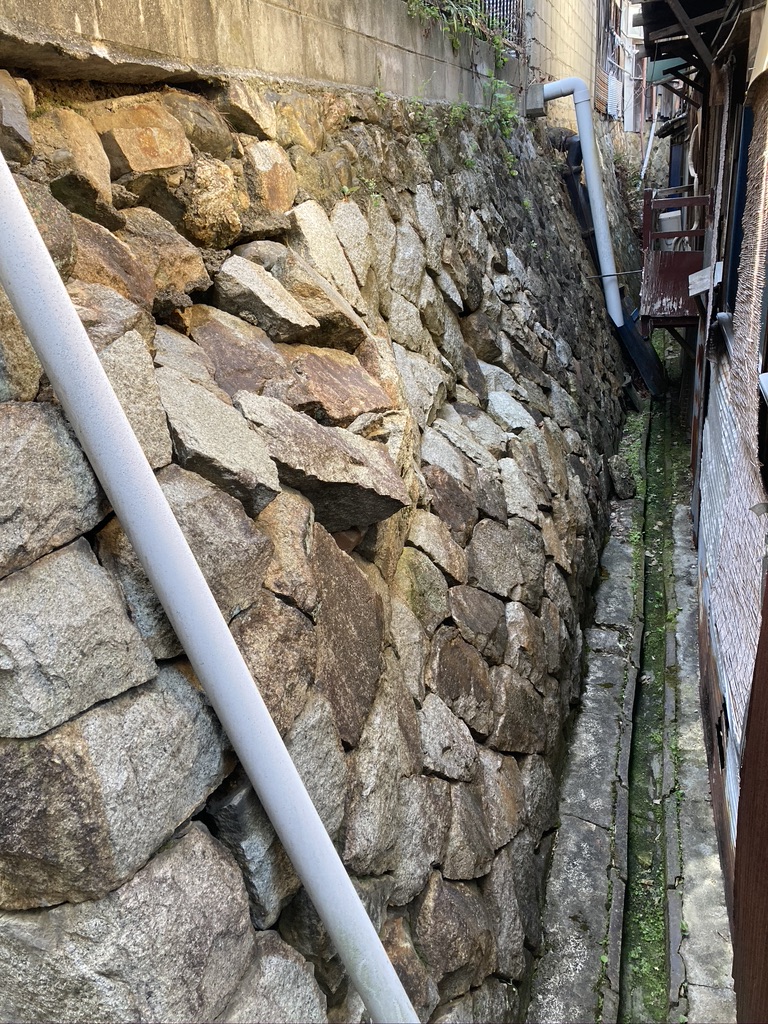
A geotechnical investigation , borehole testing or standard penetration testing , tells you what is beneath the surface before you commit capital to what sits above it. In Japan, this is not a standard step in residential land acquisition. Many buyers do not commission one. Many sellers do not provide one. The absence of investigation data at the point of purchase is common, and it is the source of a predictable class of budget problems on coastal and hillside sites.
Across projects in the Kansai region, foundation work has ranged from approximately ¥1,000,000 on straightforward sites to ¥30,000,000 on sites requiring ground improvement, deep piling, or engineered solutions for poor load-bearing conditions. That range is not driven by building size or specification. It is driven entirely by what is underground. A modest house on poor soil can carry greater foundation cost than a larger residence on stable ground.
The three broad conditions we encounter in the region: sites where standard shallow foundations are sufficient and cost remains a small portion of total project cost; sites where ground conditions require additional engineering , reinforced foundations, soil improvement, or modified bearing design , and cost rises meaningfully relative to land value; and sites, typically coastal, reclaimed, or on steep terrain, where foundation work approaches or exceeds land acquisition cost. The Awajishima project fell into that third category.
The Timing Problem
The most consequential variable in managing foundation risk is not the cost itself. It is when the cost becomes known.
Investigation data obtained before purchase preserves negotiation leverage. If subsurface conditions require expensive remediation, that cost can be reflected in the acquisition price, built into the feasibility from the outset, or used to walk away from a site that does not work at any realistic price. The buyer holds options.
Investigation data obtained after design begins introduces redesign cost and programme delay. The architect may need to revisit foundation specifications. Builder quotes already issued become provisional. Time and money are spent twice on work that should have been sequential.
Investigation data obtained after purchase, or after financial commitments are in motion, removes optionality entirely. The buyer owns the land. The project has momentum. Capital is already committed to connected decisions , landscaping, design fees, builder relationships, owner expectations. The foundation cost arrives as a fixed expense on a committed project, with no leverage remaining to recover it.
On the Awajishima project, access to the ground for testing was physically blocked until the bamboo clearance was complete. This is not unusual on vegetated hillside sites in Japan. The sequence , clear, then investigate, then build , is often the only practical option. What matters is that the project is structured to absorb that sequence: that financial commitments running in parallel are understood as provisional until the investigation result is in hand.
Investment Strategy & Consulting in Japan: structure, execution, and performance over time.
Subscribe to receive new articles from Smith Realty Japan.
What the Investigation Does Not Tell You
A geotechnical investigation produces data. It does not produce a foundation design. The interpretation of that data , what it means for the structural solution, what the engineering options are, what each option costs , requires a structural engineer working from the investigation results. On projects we consult on, we treat investigation coordination, access negotiation with the landowner or adjacent parties, contractor selection, and interpretation of findings as a connected process rather than a standalone deliverable. The investigation result is the input; the foundation cost estimate is the output; the decision is what the owner makes once both are clear.
We also verify the professionals involved in this process before engaging them on a project. A geotechnical contractor working in coastal Awajishima is operating in different conditions from one familiar with flat urban sites in Osaka. Experience at the relevant site type and scale matters, and it is something we confirm before the drill rig arrives.
Where Foundation Cost Belongs in the Process
Foundation cost belongs in the feasibility model at the point of land acquisition. On sites where investigation access is physically impossible before purchase , because of vegetation, existing structures, or access restrictions , the model should carry a range that reflects the realistic worst case for that site type. A coastal hillside site in Hyogo Prefecture is not priced as if it will behave like flat residential land in a Kobe suburb. The risk profile is different, and the budget should reflect that before the land is purchased.
On the projects where we have been involved from acquisition, this has meant carrying a foundation contingency in the feasibility from day one, commissioning the investigation as early as site conditions allow, and treating the result as a go/no-go input on the project as modelled , not as a cost to be managed after the fact. The two-day pause on the Awajishima project was a decision point that the owner navigated well. The objective is to ensure that decision point arrives with as much information as possible, and as few sunk costs as possible attached to it. Foundation cost is one of several fixed costs that should be modelled before purchase , for a full picture of registration, survey, and acquisition tax costs on a new build in Japan, see our consultant’s field notes on new-build acquisition costs.
The Awajishima project was completed. The house and gardens stand today among the finest on the island. The foundation cost was real. So is the outcome.
For a broader view of how we approach land acquisition and project feasibility on Awajishima, see our West Coast Awaji Island investment case.
Our Insights reflect how we think about investing in Japanese real estate , the questions we ask, the trends we watch, and the reasoning behind the decisions we make for our own portfolio. We share them in the hope they’re useful food for thought, but they are not advice , just one active investor’s view of the market.
More Articles
The Japanese real estate market offers unique growth potential for investors. One of the most compelling aspects is the significant ...
Author : Mark Smith
At Smith Realty, our journey has been shaped by recognizing and responding to unique opportunities. Seeking disparity in purchase and ...
Author : Mark Smith
When deciding whether to renovate or rebuild, many property owners in Japan face a challenging decision. While building new is ...
Author : Mark Smith
Six months after handover on a completed project, a prefectural tax bill arrives. The owner was not expecting it. The ...
Author : Mark Smith
Most Japan real estate developers confronting this assessment would immediately withdraw. Moreover the technical complexity, liability exposure, and cost uncertainty ...
Author : Mark Smith
Forward-thinking investors team up with Smith Realty Japan: Premier Consulting Services for Your Real Estate Projects Discerning Clients Demand our ...
Author : Mark Smith