
Six months after handover on a completed project, a prefectural tax bill arrives. The owner was not expecting it. The project was finished, the keys had been handed over, and the file — in the owner’s mind — was closed. The bill was not large relative to the total project cost, but it was real, it was due, and it had never been in the budget. That conversation happens more often than it should. On the projects we consult on, we aim to raise these costs at the land acquisition stage or at the point of receiving builder quotes — whichever comes first. Early visibility is the objective. This article explains what they are, how they are structured, and when they arrive.

When a new building is completed in Japan, it does not legally exist until it is registered. That process runs in two mandatory sequential steps, each handled by a different licensed professional.
The first step is handled by a 土地家屋調査士 (Land and House Investigator), who physically surveys the completed structure and files 表題登記 (Building Survey Registration) — the building’s initial entry onto the legal register. This is a factual record: what was built, where, and to what dimensions. Until this filing is accepted by the Legal Affairs Bureau, the building has no legal existence. It cannot be owned, mortgaged, insured through standard channels, or sold with clean title.
The second step follows. A 司法書士 (Judicial Scrivener) files the 所有権保存登記 (Ownership Registration) in the buyer’s name. This is the step that formally establishes who owns what the 土地家屋調査士 (Land and House Investigator) has just placed on the register. The sequence is fixed: ownership registration cannot proceed without the survey registration that precedes it.
In practice the two professionals often work in coordination. Builder introductions frequently come as a pair — a 土地家屋調査士 (Land and House Investigator) and 司法書士 (Judicial Scrivener) who have an established working relationship and manage the handoff between themselves. That is convenient, but the builder’s preferred professionals are not the only option. On larger projects it is worth confirming that the introduced professionals have relevant experience at that scale and specification.
The 土地家屋調査士 (Land and House Investigator) fee is broadly fixed and does not scale significantly with property value. For a standard new-build residential structure, the professional fee typically falls between ¥150,000 and ¥200,000. Complexity pushes it higher: large floor areas, multiple structures on a single lot, absent or incomplete documentation, boundary questions requiring neighbour negotiation, or mixed land classifications can all add materially to the time and therefore the cost.
Step two carries two components. The 司法書士 (Judicial Scrivener) professional fee runs roughly ¥80,000 to ¥150,000. On top of that sits 登録免許税 (Registration Licence Tax), which is calculated as a percentage of the assessed value of the property rather than the purchase price. For a new residential build, the assessed value — 課税標準額 (Kazei Hyoujungaku) — typically runs at 50 to 70 percent of the purchase price. On a ¥187,000,000 project, that puts the assessed base at roughly ¥94,000,000 to ¥131,000,000, and the registration licence tax at 0.4 percent of that figure — approximately ¥376,000 to ¥524,000. Total step two cost lands in the range of ¥460,000 to ¥674,000.
Ownership registration triggers the prefectural 不動産取得税 (Real Property Acquisition Tax). The prefecture receives notification of the registration, conducts its own assessment, and issues the bill on its own schedule — which is not immediate.
In Hyogo Prefecture, across multiple completed projects, the bill has arrived approximately six months after ownership registration. Other prefectures may run longer — the general range is six to twelve months — but six months is a reliable working figure for Hyogo. For context on how institutional investors approach Japanese real estate more broadly, see our notes on the GPIF real estate strategy.
The tax is calculated on the assessed value, with a standard 50 percent reduction applied to the base for new residential builds, and a flat rate of 3 percent applied to the result. On a ¥187,000,000 project this produces a bill in the range of ¥1,400,000 to ¥1,970,000, before any additional deductions that may apply based on floor area or construction date.
The deferred arrival is what catches buyers off guard. By the time the envelope from the prefecture arrives, the project is complete, handover has been done, and acquisition costs feel like a closed chapter. The bill is not unexpected when it has been modelled — and only modelable before the land is purchased.
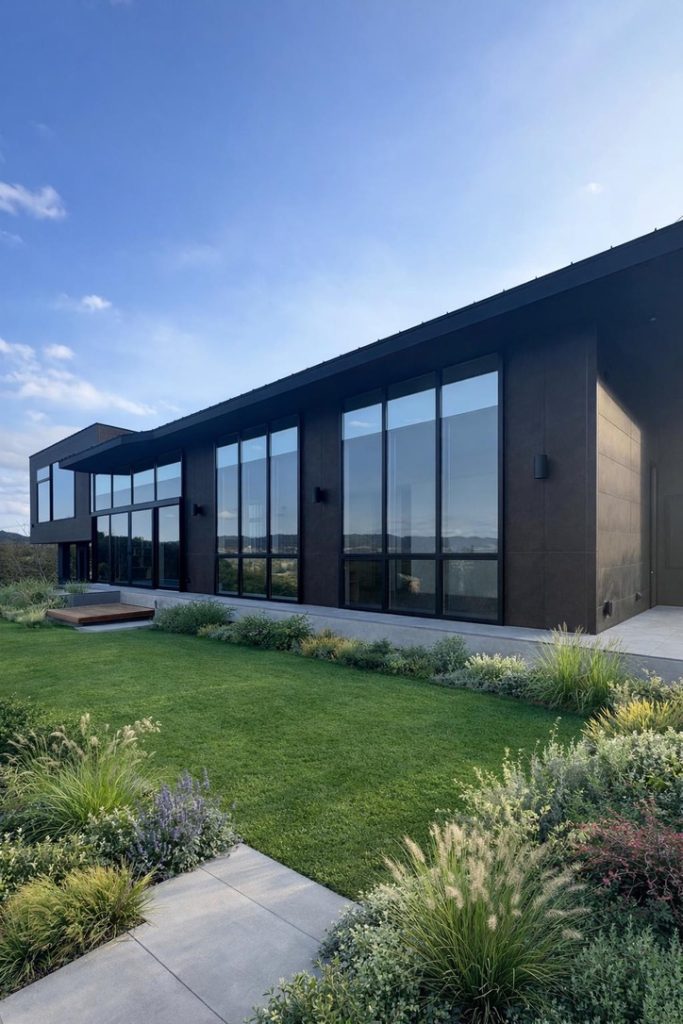
Vista Wellmina Villa — listed at ¥187,000,000 at the time of writing — is a project we delivered on Awajishima, and a useful worked example because all the relevant variables are known. Architect-designed, two-storey wood construction, completed February 2026. Building area 147.80m² on a freehold land parcel of 905.41m² (approx. 273.88 tsubo) in Ei, Awaji City, Hyogo Prefecture. Outside designated zoning area, which can affect how the assessed value is calculated.
The three steps against this project:
Step 1 — 土地家屋調査士 (Land and House Investigator), 表題登記 (Building Survey Registration): approx. ¥150,000 – ¥200,000
Step 2 — 司法書士 (Judicial Scrivener) fee plus 登録免許税 (Registration Licence Tax): approx. ¥460,000 – ¥674,000
Assessed value est. ¥94M – ¥131M × 0.4%
Step 3 — 不動産取得税 (Real Property Acquisition Tax), Hyogo Prefecture, est. 6 months post-registration: approx. ¥1,400,000 – ¥1,970,000
(Assessed value × 50%) × 3% before applicable deductions
Indicative total: ¥2,010,000 – ¥2,844,000
On a ¥187,000,000 project that is approximately 1.1 to 1.5 percent of the purchase price — a manageable number when it is in the model, a disruptive one when it is not.
These figures are indicative. Assessed value varies by municipality and build specification, and the 不動産取得税 (Real Property Acquisition Tax) reductions available for new residential builds can be significant depending on floor area and classification. A Japanese accountant should confirm the actual numbers before they are treated as fixed.
Building a Custom Home in Japan — design, coordination, and build execution.
Subscribe to receive new articles from Smith Realty Japan.
The sequence above is not a framework we developed in isolation. It is what we have been through on every project we have delivered.
Mikage House in Kobe was built on land the owner personally identified and secured — a site that required complete demolition of a rusted steel-and-concrete deck spanning 68 square metres before construction could begin. We introduced the architect, Takashi Sakae of ABAX Architects, managed all quotations, attended every design meeting, and maintained site presence through construction. The registration sequence followed completion as described: survey registration, ownership registration, and a prefectural tax bill arriving on the prefecture’s schedule months later. The complexity of that site — demolition, ground preparation, non-standard starting conditions — meant costs had to be modelled from first principles. There was no comparable project to borrow a number from.
Sunset Villa on Awajishima, completed in 2024, was delivered for an experienced investor in the Japanese market — not a first project, and not a client who needed these costs explained at handover. Registration and acquisition tax were in the model from the outset. That is the working standard we apply.
Vista Wellmina Villa was the third residence we delivered for the same international investor on the Awajishima coastline. We identified the land, negotiated the acquisition, introduced the architect and builder, supervised the quoting phase, attended every design meeting, maintained daily site presence through construction, and stood with the owner at handover to negotiate remedial items — reducing a 48-point punch list to three. The registration and acquisition tax costs set out in the worked example above applied directly to this project. They were in the budget before the land was purchased.
One situation that comes up, particularly with older rural properties: an unregistered building can be legally advertised for sale. When a buyer is found, 表題登記 (Building Survey Registration) and 所有権保存登記 (Ownership Registration) are completed in the buyer’s name directly — the seller never having appeared on the register. The registration costs and the subsequent 不動産取得税 (Real Property Acquisition Tax) fall entirely to the buyer.
This is not unusual in rural Japan, particularly with kominka, where previous owners avoided the registration process and its tax consequences. It is a legitimate mechanism. The buyer needs to understand what they are absorbing — an unregistered building is typically discounted to reflect this, but the discount is only useful if the costs being assumed have been quantified.
An additional complication with older unregistered structures: there is sometimes no surviving documentation of original construction. The 土地家屋調査士 (Land and House Investigator) must then do investigative work to establish what exists before the survey registration can be filed. That adds time and cost that is not present on a straightforward new build.
Registration fees and acquisition tax are fixed costs of owning a new building in Japan. On a ¥187,000,000 project they run to approximately ¥2,000,000 to ¥2,800,000 across three stages — the last arriving around six months after ownership registration, well after the project feels complete.
We build them into every project budget at the land acquisition stage. That is the point at which they are useful. Discovered later, they are simply an unplanned cost on a project that has already been committed. For a broader view of how we approach new-build investment on Awajishima, see our West Coast Awaji Island investment case.
Our Insights reflect how we think about investing in Japanese real estate — the questions we ask, the trends we watch, and the reasoning behind the decisions we make for our own portfolio. We share them in the hope they’re useful food for thought, but they are not advice — just one active investor’s view of the market.