The land was contaminated. The surrounding area carried the stigma of decades of industrial use. Residential buyers avoided it. Agents weren’t listing it. The price reflected all of that — roughly one-fifth of what clean residential land was trading for one street away.
That is where we started building our rental portfolio in Kawanishi, Kansai.
Not because the site was attractive. Because the gap between what the land was priced at and what it would become — once a ¥35 billion municipal remediation programme ran its course — was legible to anyone willing to work through the numbers and hold conviction long enough to matter.
That cycle took the better part of two decades. The land is now priced in the range of ¥700,000 to ¥1,200,000 per tsubo. The neighbouring street — clean, residential, unremarkable — sits at roughly the same level it was when we began. The market has no memory of what it missed.
We have written about the framework behind that cycle in detail in Disparity Arbitrage in Japan’s Stagnant Property Market. What we want to do here is explain how that experience shapes the way SmithRE approaches investment today — and what it means in practice for international clients considering Japanese real estate.
Where New Eyes Read Stigma as Opportunity
Kawanishi carried real stigma. The area’s association with industrial contamination and its history as a working district meant that many Japanese buyers simply wouldn’t look at it. That aversion was baked into the price. It was also, in our assessment, running on memory rather than present reality.
We came to this market with new eyes. We had no inherited instinct to avoid the area, and no particular weight attached to the local aversion that had kept others away. What we saw instead was a location with a specific problem — a factory nearby, ongoing industrial use, a contamination question — set against an array of positives that the price was not reflecting: infrastructure access, proximity to Osaka, a remediation programme already in motion, and a municipal authority that had made a clear long-term commitment to the area’s transformation.
The factory was a live concern, not a dismissed one. We worked through the scenario in which it stayed, the stigma held, and the land went nowhere. We accepted that outcome as possible. What we couldn’t construct was a credible case in which all the surrounding signals — the institutional investment, the demographic pressure, the infrastructure spend — pointed consistently in one direction and the asset remained permanently mispriced. The downside was real. The asymmetry was more real.
That is the same pattern we are watching on Awajishima’s west coast today. The island carried its own form of neglect — decades of outmigration, an ageing economy, infrastructure that hadn’t kept pace. That history is still in the price of land on parts of the coastline. What is also now present, and not yet fully reflected in valuations, is a scale of institutional commitment — Pasona’s relocation, the Expo 2025 catalyst, hospitality and residential capital arriving from outside Japan — that changes the underlying case materially. The methodology is the same. The market is earlier in the cycle. We spoke with an investor just recently who looked at the island and said: “Mark, I don’t see it — crossing the bridge is expensive.” The North Shore of Sydney Harbour has been among the most prized residential land in Australia for generations. The commute into the CBD can be horrendous. Nobody discounts the North Shore for the bridge. What they see is the water, the escarpment, the amenity — and they pay accordingly. We see the same logic on Awajishima’s west coast: scenic coastal land connected to the Kansai mainland by a six-lane, four-kilometre crossing running at 80 kilometres per hour, carrying over 23,000 vehicles a day. The Akashi Strait toll is ¥2,570. On a premium asset held over a decade, that is not a cost. It is the friction that keeps the pricing where it is.
How Our Portfolio Was Built
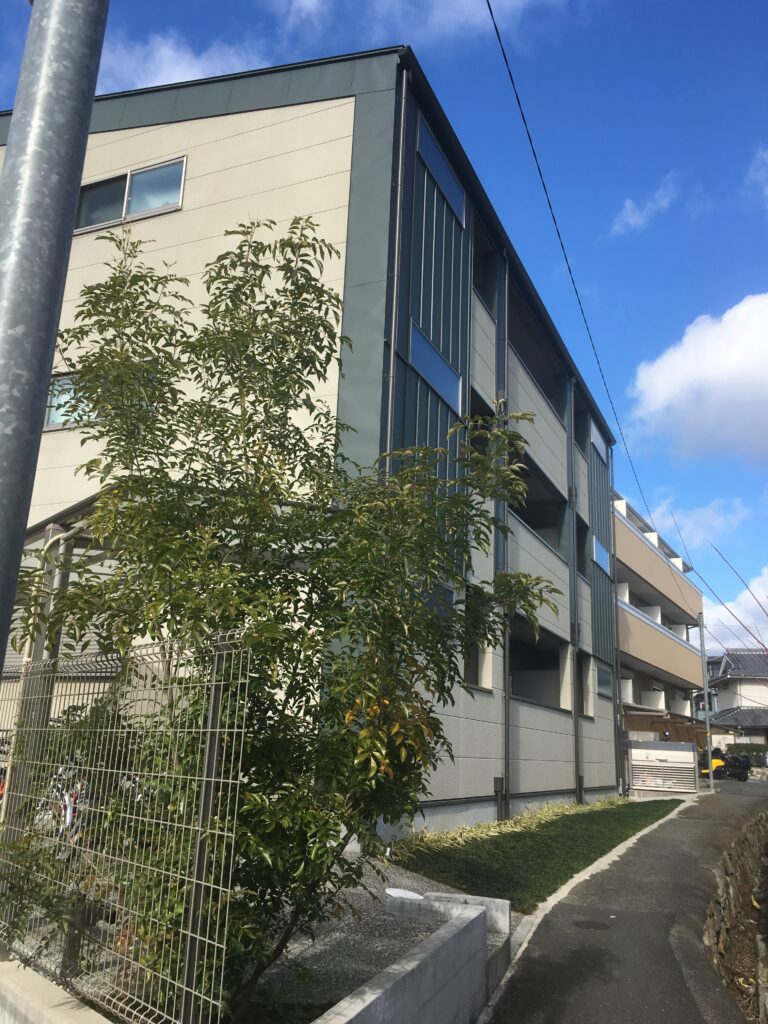
Our rental portfolio in Hyogo Prefecture was not assembled quickly and it was not assembled through luck. It was built incrementally, starting from stigmatised industrial land acquired at a significant discount to surrounding residential values, through a structured programme of new residential construction that we executed and managed directly.
The buildings are standard reinforced concrete residential construction — the kind of asset that produces reliable, long-duration income in Japan’s rental market when it is correctly positioned, correctly managed, and correctly maintained. Occupancy across the portfolio has run at or near capacity for an extended period.
The income from that portfolio is what funds the consulting work. It is also what grounds it. When we advise a client on yield assumptions, cost structures, or management decisions, we are drawing on direct experience of what those numbers look like in practice — not in a spreadsheet, but in a building that we own and operate.
That is a different basis for advice than most consultants in this market are offering.
Building a Custom Home in Japan — design, coordination, and build execution.
Subscribe to receive new articles from Smith Realty Japan.
We write only when something is worth paying attention to.
Where We See Opportunity Now
Japan’s residential investment market has two broad dynamics running simultaneously, and they require different thinking.
In major urban centres — Tokyo, Osaka, Fukuoka — demand from international capital has pushed yields down and acquisition prices up. The arithmetic still works for some buyers, particularly those with long time horizons and access to yen-denominated financing. But the gap between price and underlying value has compressed significantly in the assets that are most visible to international buyers.
Away from those centres, the picture is more complex and more interesting. Certain coastal and regional markets — Awajishima’s west coast being one we have been watching closely — are repricing in response to infrastructure investment, demographic inflows from urban areas, and deliberate positioning by institutional and hospitality capital. The catalyst structures are legible. The pricing has not yet fully caught up.
We are not predicting outcomes. We are describing what we observe and how we think about it. The Awajishima west coast investment case is set out in detail in a separate article. The broader framework for identifying this kind of disparity — the conditions under which Japanese real estate produces outsized returns over extended holding periods — is what the Disparity Arbitrage article is built around.
Investment Construction: What We Do and Do Not Do
SmithRE consults on residential investment development in Japan. That means land, design, construction, and the decisions that run across all three.
We assist international clients in identifying land with genuine investment logic — not just available land, but land where the relationship between current pricing, permitted use, construction cost, and achievable yield produces a rational case. We work through architect selection, builder tendering, and construction oversight. We operate in Japanese, across the full range of documentation and negotiation that a project requires.
What we do not do is act as a licensed agency. Conveyancing and formal transaction services are handled through our partner agency, Life-Flex, which holds the required licensing. We are clear about that boundary because it matters — conflating consulting and agency services in the Japanese market creates liability exposure for clients that a properly structured engagement avoids.
We also take on one construction consulting project per year. That is not a marketing position — it is a capacity decision. The work requires sustained on-site presence and direct engagement with architects and builders through the full build cycle. We are not structured to dilute that.
What New Eyes Consistently Get Wrong
The most common failure pattern we observe is not financial. It is informational.
Investors new to Japanese real estate tend to rely on English-language market commentary, agency-produced reports, and the visible end of the transaction — the listing, the price, the projected yield. What they do not have access to, and what is rarely explained to them, is the operational layer underneath: how Japanese builders price risk into contracts, how architects interpret briefs in ways that create cost exposure later, how municipal approval timelines affect financing, and how the decisions made during construction — not at signing — determine whether a project delivers what the initial underwriting assumed.
The gap between what a project looks like at the point of purchase and what it looks like at completion is where most investment underperformance in this market originates.
We have seen this from the inside often enough to structure our consulting work around it. The due diligence phase, the architect brief, the builder selection process, and the construction oversight stage are not procedural checkboxes. They are where the investment outcome is determined.
The Rental Portfolio as Operating Evidence
We are sometimes asked why we publish details of our own portfolio — the land we acquired, the prices we paid, the income it produces. The answer is straightforward: in a market crowded with people offering opinions on Japanese real estate, the portfolio is the evidence that the thinking has been tested in practice.
Our rental buildings in Hyogo are not hypothetical. The occupancy figures are not modelled. The income is not projected — it is generated, year after year, from buildings we designed the investment logic for, constructed with architects and builders we selected and managed, and have operated continuously since completion. SOFIEL III is one case study from that portfolio.
That is what we mean when we say we are active investors, not consultants who have observed the market from a distance. The distinction is not rhetorical. It shapes every recommendation we make.
Working with SmithRE on Investment
Clients who engage SmithRE on investment typically come with one of three briefs: they want to understand whether a specific asset or market makes sense; they want to develop a site and need end-to-end consulting across land, design, and construction; or they want a second opinion on a transaction or project that is already in motion.
In each case, the starting point is the same — a direct conversation about what the client is actually trying to achieve, what their time horizon and risk tolerance look like in practice, and what the Japanese market will and will not support given those parameters.
We do not produce polished investment decks or generic market overviews. We work through specific situations, with clients who are serious about operating in this market, grounded in the experience of having done it ourselves.
If that is the conversation you are looking for, the Contact page is the place to start.
Our Insights reflect how we think about investing in Japanese real estate — the questions we ask, the trends we watch, and the reasoning behind the decisions we make for our own portfolio. We share them in the hope they’re useful food for thought, but they are not advice — just one active investor’s view of the market.
"Filmed in 2010 with rudimentary equipment — shot by builders."

 At Smith Realty Japan, real estate investment is more than a business—it’s the passion that drives us. Our founders’ journey through Japan’s dynamic property landscape reflects a commitment to forward-thinking strategies that adapt to evolving markets and embrace innovation.