
Renovation in Japan covers a wider spectrum than most buyers and investors initially appreciate. It ranges from the careful restoration of a century-old timber kominka — every joint hand-cut, every tile reseated by someone who understands what they are working with — to the demolition of a failed hotel’s upper floors and the architectural conversion of its retained concrete base into four Minpaku residences. Between those two points sits the concrete reform: a dated 1980s structure repositioned for today’s coastal lifestyle buyer through a full modern fit-out.
We have been directly involved in all three. Each required a different skill set, a different network, and a different investment logic. What did not change across any of them was the discipline: honest assessment before commitment, defined scope before contractor engagement, and a clear understanding of what the finished building is for.
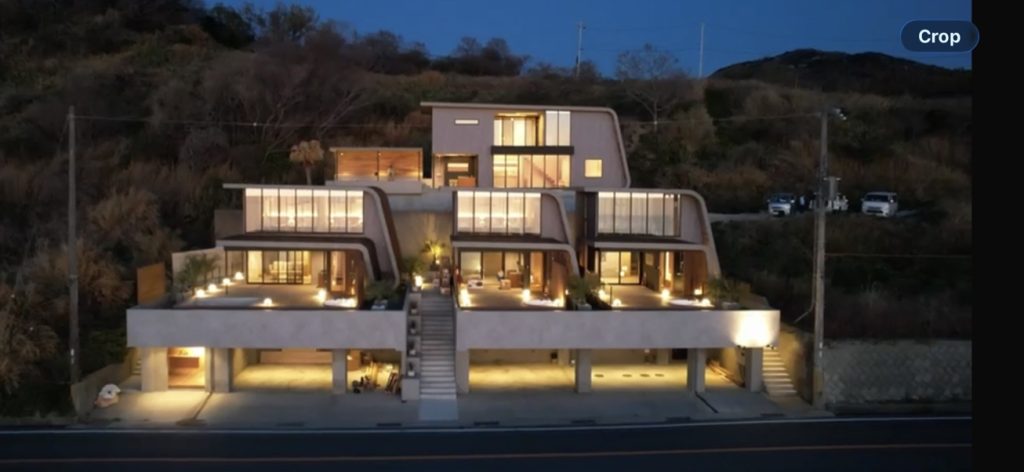
A distressed hotel on the coastal highway at Fukukusa, southern Awajishima. The upper floors had deteriorated beyond viable repair. The ground floor — reinforced concrete garage structure — was sound. The investment thesis was straightforward: acquire at distressed hotel pricing, demolish the failed upper floors, retain and structurally verify the existing RC base, and commission four architect-designed Minpaku units on foundations that would have cost significantly more to build from scratch.
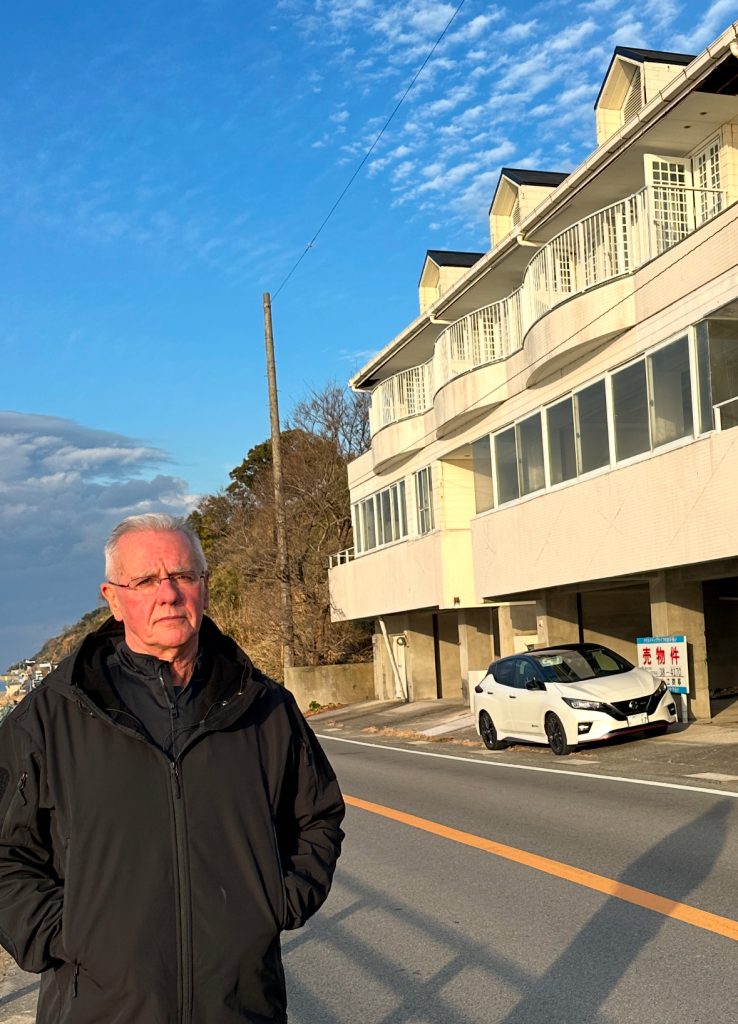
The project was led by an architect within our network — the same architect who has designed two villas for our clients on Awajishima. When the demolition phase presented specific challenges, he called us in. The building’s entire exterior cladding contained asbestos. The site sat directly adjacent to a major coastal highway. Both conditions require a level of precision and regulatory compliance that goes well beyond standard demolition practice.
We managed the demolition — asbestos removal carried out by licensed specialists under controlled conditions, structural demolition of the upper floors executed with highway access maintained throughout. We then carried in the water mains and electrical infrastructure for the converted units. The result, visible in the drone photography taken at completion, is four individually designed Minpaku residences on a coastal site with Seto Inland Sea outlook — built on a foundation that cost a fraction of what new construction would have required.
This project illustrates something about how serious renovation work in Japan actually functions. The network matters as much as the individual capability. An architect leading a complex conversion calls in the demolition expertise he trusts. The demolition contractor coordinates with the infrastructure trades. Each party operates in their area of competence and the result reflects that discipline. SmithRE does not always lead. Sometimes we are the party a trusted colleague calls when the job gets technically demanding.
Nushima is a small island off the southern tip of Awajishima — ten minutes by ferry from Habu Terminal, a working fishing community of around 700 people. It is the kind of place that does not appear on most real estate searches. It is also the kind of place where Japan’s akiya situation is personal rather than statistical — two of the buildings we came across were inherited, unwanted, and without a clear path forward.
Both owners were younger generation — city dwellers with no connection to the island and no capacity to maintain buildings they had inherited but did not want. In a community of 700 people, there is not enough local income or population to absorb these properties. Without intervention, the trajectory is predictable: deferred maintenance, structural deterioration, eventual collapse.
We bought both on the same day. The intention was renovation for personal use. We began with the older of the two — a 100-year-old kominka positioned at the trailhead leading to Nushima’s famous Kamitategamiiwa — a 30-metre sacred rock where, according to Shinto mythology, a god carved a heart for his wife. Roof first: kawara tiles reseated on new clay base, structural timbers assessed, period-appropriate lumber sourced through our demolition network where replacement was needed. Exterior walls followed. By the time the envelope was complete — weathertight, structurally sound, restored to its original character — a client asked us what we thought about kominka on Nushima.
We showed him both buildings. He saw the completed roof and walls on the first, understood what the restoration had achieved, and made an offer on the spot. We sat down and went through our costs — acquisition, materials, contractor fees, completed work — and our honest assessment of what he would need to spend to complete the interior to his standard. He bought it on those numbers. That is how the transaction should work: transparent costs, realistic future scope, no optimism that serves the vendor at the buyer’s expense. He is now fitting out the building as a bakery at the trailhead — the starting point for hikers heading to Nushima’s famous coastal rock outcrop. The building that was heading toward collapse is becoming a reason to visit the island.
The second kominka we kept. It is ours — a harbour-front building overlooking Nushima’s working fishing harbour, small boats moored just metres away. The interior is being worked through carefully, without urgency, in a building we intend to use for the long term. Getting on that ferry — watching Habu Terminal recede, the Seto Inland Sea opening up, Nushima’s silhouette growing clearer — the stress of the mainland is gone before you arrive. That is what these buildings offer that no new-build can replicate. It is not sentiment. It is a genuine quality of life that is becoming increasingly rare and increasingly valued.
Kominka renovation requires contractors with specific skills: kawara tile work, traditional plastering, shoji and fusuma joinery, period-appropriate timber matching. An inexperienced contractor working cheaply on a heritage timber structure can cause irreversible damage to materials that cannot be replaced. On Nushima, the additional reality is ferry access — every trade, every materials delivery, every equipment movement depends on the timetable. That is a logistical variable that needs to be understood and costed before any renovation budget is committed.
Reform & Renovation in Japan — structure, process, and project execution.
Subscribe to receive new articles from Smith Realty Japan.
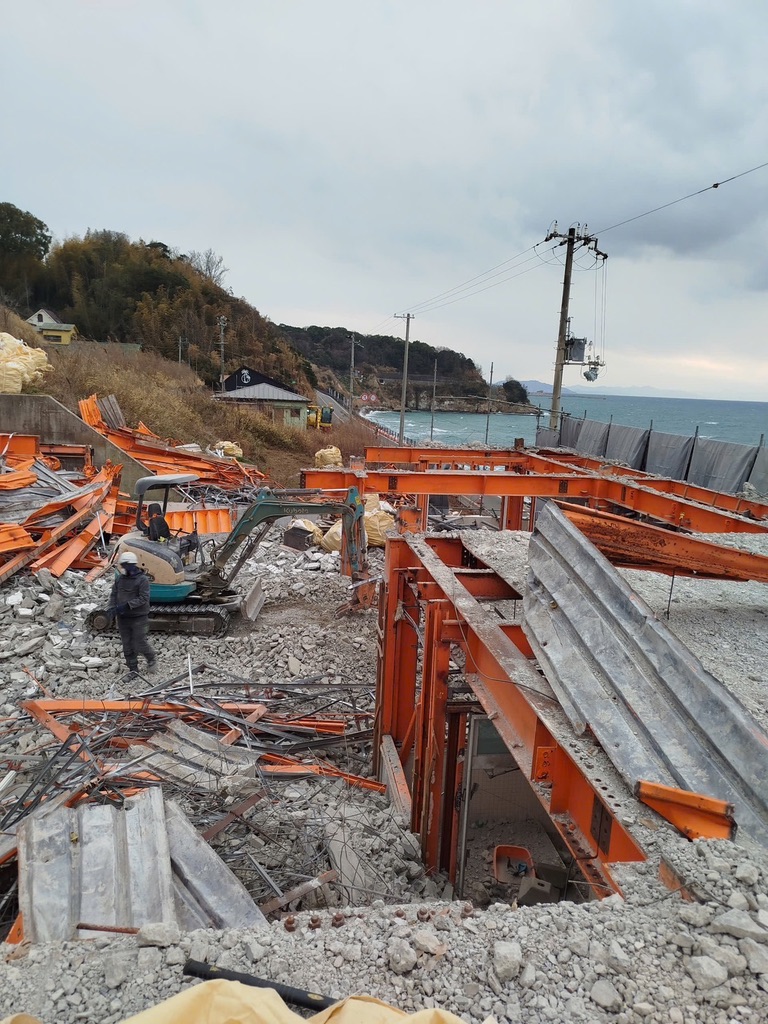
A 1980 reinforced concrete home in Ei-Nishitani, Awaji City — ocean frontage, west-facing, 92.74 square metres on 200.74 square metres of freehold land. Structurally sound. Dated interior. The kind of property the domestic market prices on its age and overlooks on its position.
We identified the property, introduced the builder, oversaw the full reform, and reported to the owner throughout. No personal capital — pure consulting. The renovation scope was driven entirely by the target buyer: a coastal lifestyle purchaser who wants ocean views, modern functionality, and a property ready to use from day one. High ceilings reworked to expand internal volume. Two-metre doorways removing visual barriers. Open-plan living. Custom kitchen. Two modernised bathrooms. The building’s concrete bones were left to do what they were built to do. Everything else was rebuilt around the outlook.
The result is a fully reformed coastal home listed at ¥32,900,000 — a price point that reflects the position, the specification, and the work done, while remaining accessible relative to comparable coastal property on the Kansai mainland. Pricing discipline is part of the consulting brief. A renovation that overshoots the market it is targeting produces an unsaleable asset regardless of the quality of the work.
Whether the building is a century-old kominka, a 1980s concrete structure, or a distressed hotel with an asbestos exterior, the process begins the same way — with an honest assessment of what is actually there. Not an optimistic reading shaped by enthusiasm for the opportunity, but a methodical look at the structure, the systems, the site, and the regulatory obligations.
For kominka, that means timber condition — white ant damage, water infiltration, rot in contact zones, subfloor deterioration. Roof structure and tile integrity. Asbestos risk in any structure renovated between the 1950s and 1980s. For concrete structures, it means the RC frame, waterproofing and exterior finish condition, plumbing and electrical systems, and seismic compliance relative to Japan’s 1981 building code revision. For larger conversion projects, it means structural engineering assessment of what is being retained and what the retained elements can bear.
The assessment shapes the scope. The scope shapes the budget. The budget shapes the acquisition price. This sequence — assess, scope, budget, acquire — is the only order that produces reliable outcomes. Beginning with a committed acquisition price and working backwards to justify it is how renovation projects become financially painful.
Renovation motivation in Japan falls broadly into three categories, and being clear about which applies changes every decision that follows.
Investment value uplift — acquire below replacement cost, renovate to a defined scope, reposition at a materially higher value. The Fukukusa hotel conversion and the Ei-Nishitani reform both follow this logic, from different starting points and at very different scales.
Personal use — the Nushima kominka we kept is this. The renovation scope is personal, the timeline is not urgent, and the building is being worked through carefully for long-term use. Different decisions, different pace, different standard of finish than an investment-driven brief.
Rental income — the Fukukusa Minpaku conversion is explicitly this. Four individually designed short-stay residences in a location with genuine coastal lifestyle appeal and direct access to southern Awajishima’s tourism corridor. The renovation specification here is driven entirely by guest experience requirements.
There is a practical reason why renovation has become a more active part of our work. The arithmetic of buying land and building new residential rental property in Japan has changed significantly — land prices in our area of focus have moved by a factor of eight in seven years, and construction costs have followed in their own right. The gap between what a new build costs and what rental income can support has narrowed to a point where new-build-for-rent no longer works at our scale at current entry prices.
Renovation — acquiring an existing structure at the right price, improving it to a defined scope, and repositioning it either for sale or for income — offers a route to returns that new construction currently does not. The Fukukusa conversion retained an existing RC foundation rather than building one. The Nushima kominka was acquired at a price that reflected its condition, not its potential. The Ei-Nishitani reform identified a building the domestic market had underpriced relative to its position. In each case the entry point was the decision. That is not a philosophical position. It is what the numbers are telling us.
For further context on kominka and heritage properties, see our Kominka & Heritage Properties Insights. For the broader Awajishima investment context in which all three of these projects sit, see the West Coast Awaji Island investment case.
Our Insights reflect how we think about investing in Japanese real estate — the questions we ask, the trends we watch, and the reasoning behind the decisions we make for our own portfolio. We share them in the hope they’re useful food for thought, but they are not advice — just one active investor’s view of the market.